Disclosure: NORD is an Amplemarket partner. The method and opinions are my own.
Logistics is one of the hardest markets to prospect in Brazil. Decision-makers are on the operations floor, not on LinkedIn all day. Buying cycles depend on seasonality. And almost every technology vendor shows up with the same line about "cutting freight costs".
The topic weighs on results: according to Ilos's annual study, logistics costs took up 15.5% of Brazil's GDP in 2025, with transportation alone accounting for 8.5 points. That's why companies with their own fleet watch routing, cost per delivery and service level all the time [1].
In this article I open up the method I use to prospect companies with their own fleet, using Amplemarket as the data and signals layer and Claude as an account analyst via MCP. It's not a button-by-button tutorial. It's the logic behind each choice, so you can adapt it to your product.
Video (in Portuguese): How I use Amplemarket to prospect logistics in Brazil (3 min)
1. The most common mistake: defining the ICP by industry
People selling into logistics usually filter by "Transportation, Logistics & Supply Chain" and stop there. The problem is that this industry mixes four businesses with completely different pains and buyers:
Company type | How delivery works | Who decides | Does it fit a routing vendor? |
|---|---|---|---|
Logistics operator (3PL) | Delivery is the product it sells | Operations and IT leadership, long cycle | Sometimes, but often has its own system |
Carrier | Sells freight, often with contracted drivers | Owner or director | Depends on size |
Distributor, wholesaler, manufacturer, retailer | Delivery is cost and service level | Logistics, operations and the owner | Yes: the core of the ICP |
E-commerce with its own logistics | Delivery is a brand promise | Operations and CX | Yes, in last-mile operations |
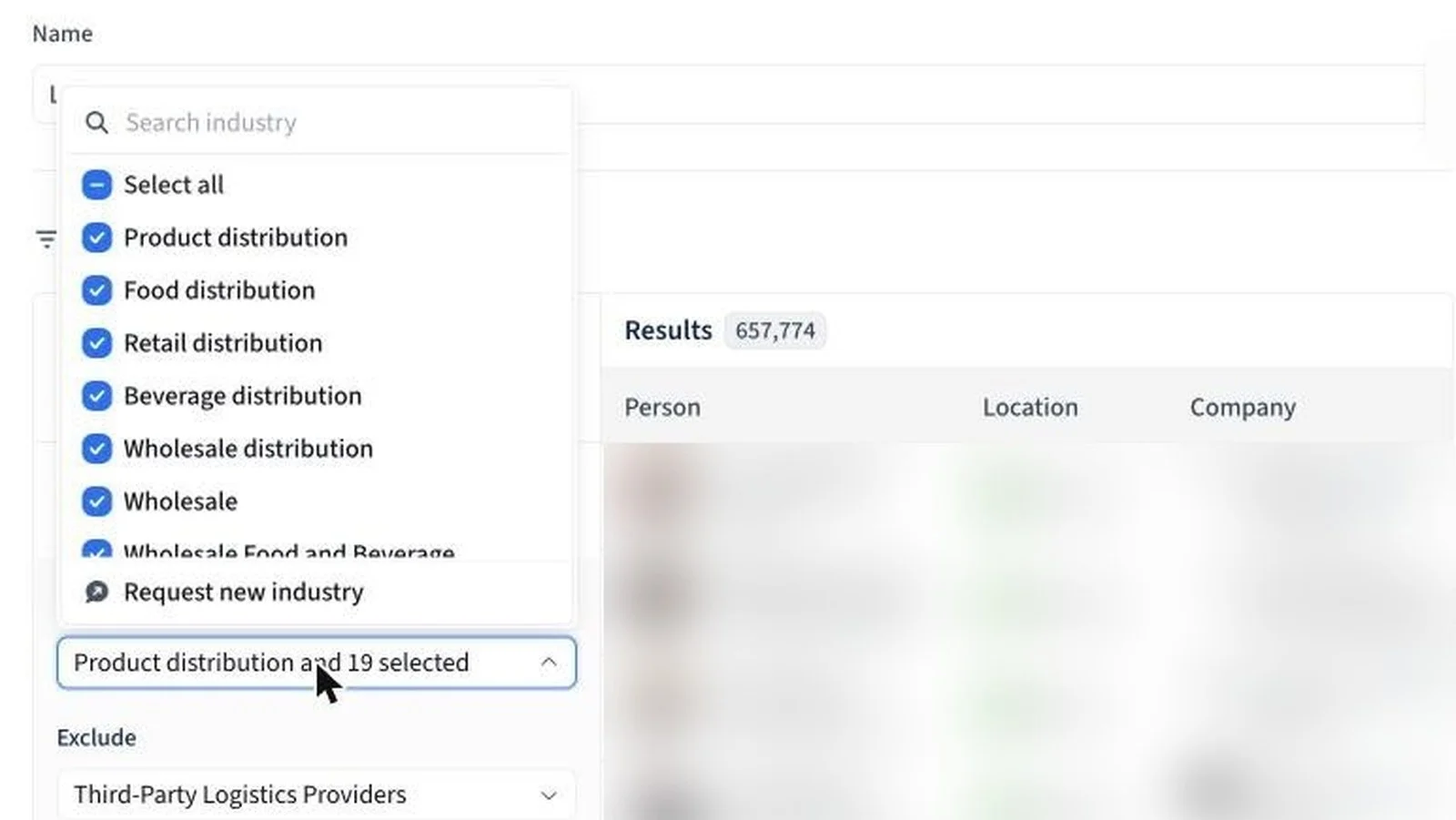
That's why my territory in Amplemarket doesn't start from the "logistics" industry. It starts from who runs their own fleet and feels delivery in the bottom line: food, beverage and product distribution, wholesale, supermarkets, food and beverage manufacturing, e-commerce, building materials and pharmaceutical distribution. And I explicitly exclude 3PLs.
Rule of thumb: if the company sells freight, it's your customer's competitor or partner, not your customer.
2. Personas: who feels the pain and who signs
In logistics, the person who feels the problem is rarely the one who approves the purchase. I work with five personas, each with a clear role:
Persona | Role in the purchase | What they want to hear |
|---|---|---|
Transportation and fleet manager | Feels the pain every day and influences the choice | Less rework in routing, fewer routes that miss delivery windows |
Logistics decision-maker (director/head) | Owns the operations budget | Cost per delivery, service level, predictability |
Operations executive (COO) | Approves when the topic reaches the business level | Growth without growing the structure at the same rate |
IT evaluator | Can veto | ERP/TMS integration, security, implementation effort |
AI and innovation leader | Sponsor in more mature companies | A concrete, measurable AI use case in operations |
A note on Brazil: in mid-sized distributors, the decision-maker is often the owner or partner. That's why I include the "Founder / Owner" level in decision-maker searches. Without it, you miss exactly the accounts where conversations move fastest.
3. Why a job change isn't enough
Job changes and promotions are still useful signals, but they've become the baseline. Everyone gets the same alert in the same week and sends the same message.
In logistics, the buying moment shows up in operational events, not in titles. That's why I organize signals in three layers:
Layer | Signal examples | What it indicates | Useful window |
|---|---|---|---|
1. Operations changing | Openings for drivers, routers or fleet coordinators; new distribution center or branch; vehicle purchases | Operations are growing or under pressure right now | Short, 2 to 6 weeks |
2. Company changing | Funding, acquisition, expansion into a new region, new logistics leader | Budget and willingness to revisit processes | Medium, 1 to 3 months |
3. Interest in the topic | Engagement with content about routing, last mile and fleet; mentions in a podcast, talk or news | The topic is on the person's mind | Variable: use it to warm up |
Amplemarket aggregates more than 30 data sources and lets you build your own signals, via CRM or webhook, on top of the native ones [2][3]. The real gain comes from stacking signals: an account with an open router position (layer 1) and a new logistics director (layer 2) takes priority over an account with a single signal.
4. In practice: from search to my own signal
The step-by-step I follow:
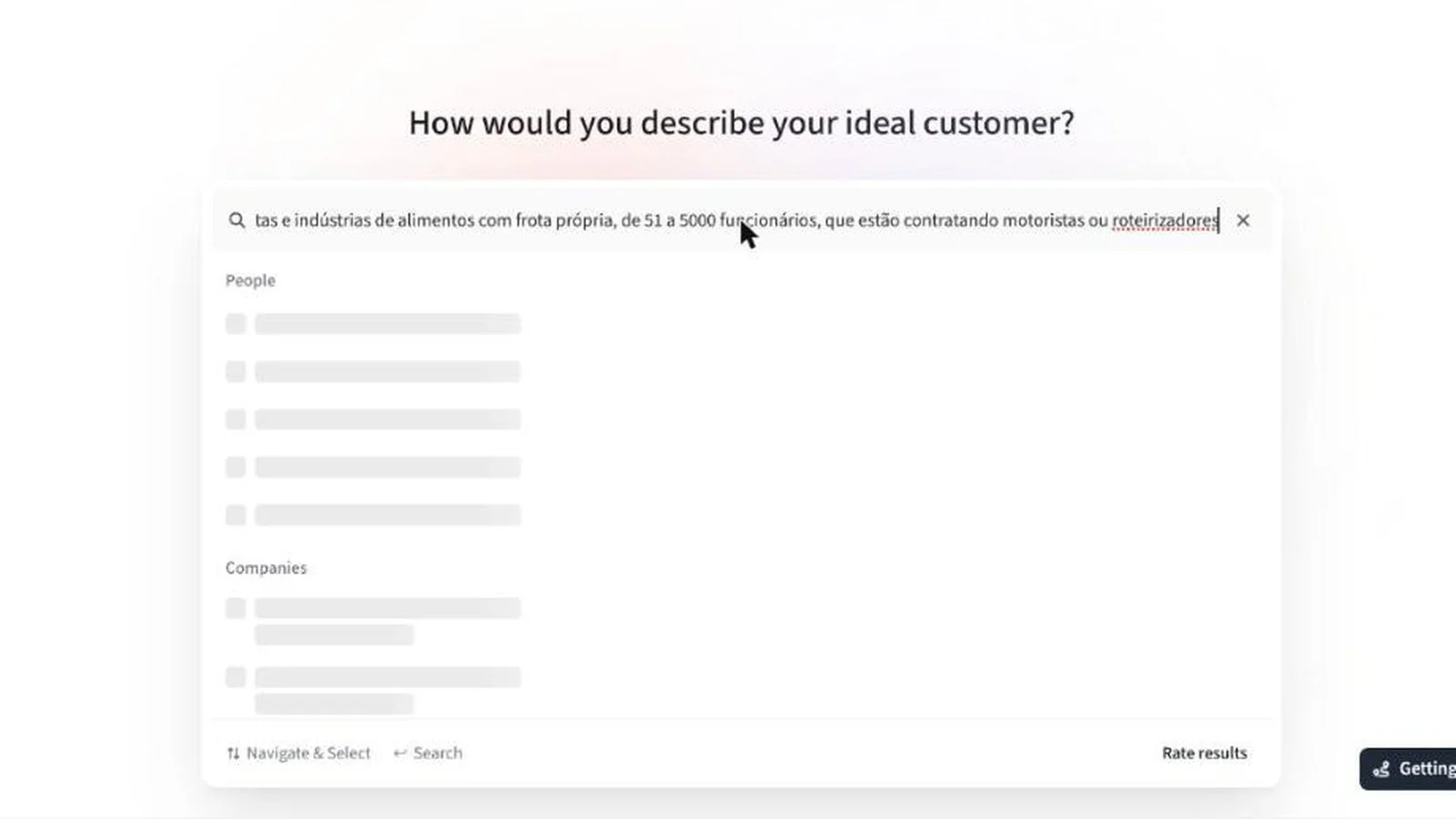
I ask for the search in natural language, the way I'd brief an SDR: "logistics, transportation and fleet managers in Brazil, at distributors and manufacturers with their own fleet, 51 to 5,000 employees". The platform turns that into filters, and I review each one before saving.
I apply a layer-1 signal. On top of the saved fleet-manager search, I filter companies hiring drivers or routers. A universe of thousands of people shrinks to a small group of accounts with a concrete reason to talk.
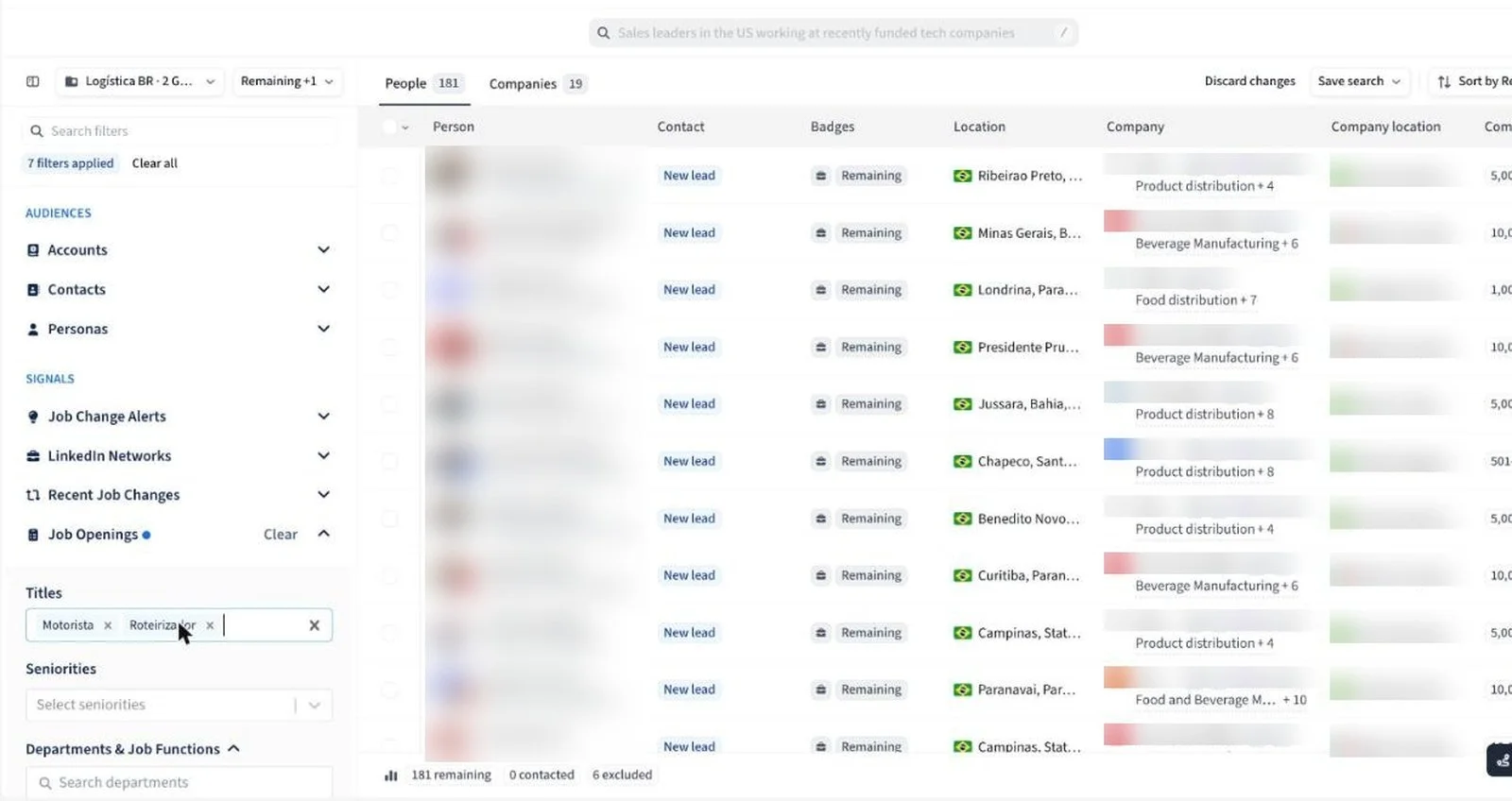
I turn the filter into an agent. Running that search by hand every week doesn't scale. So I built an agent in Duo Copilot that watches fleet and routing job openings, only within my personas and industries, and caps it at 1 lead per company so it doesn't reach several people at the same account at once.
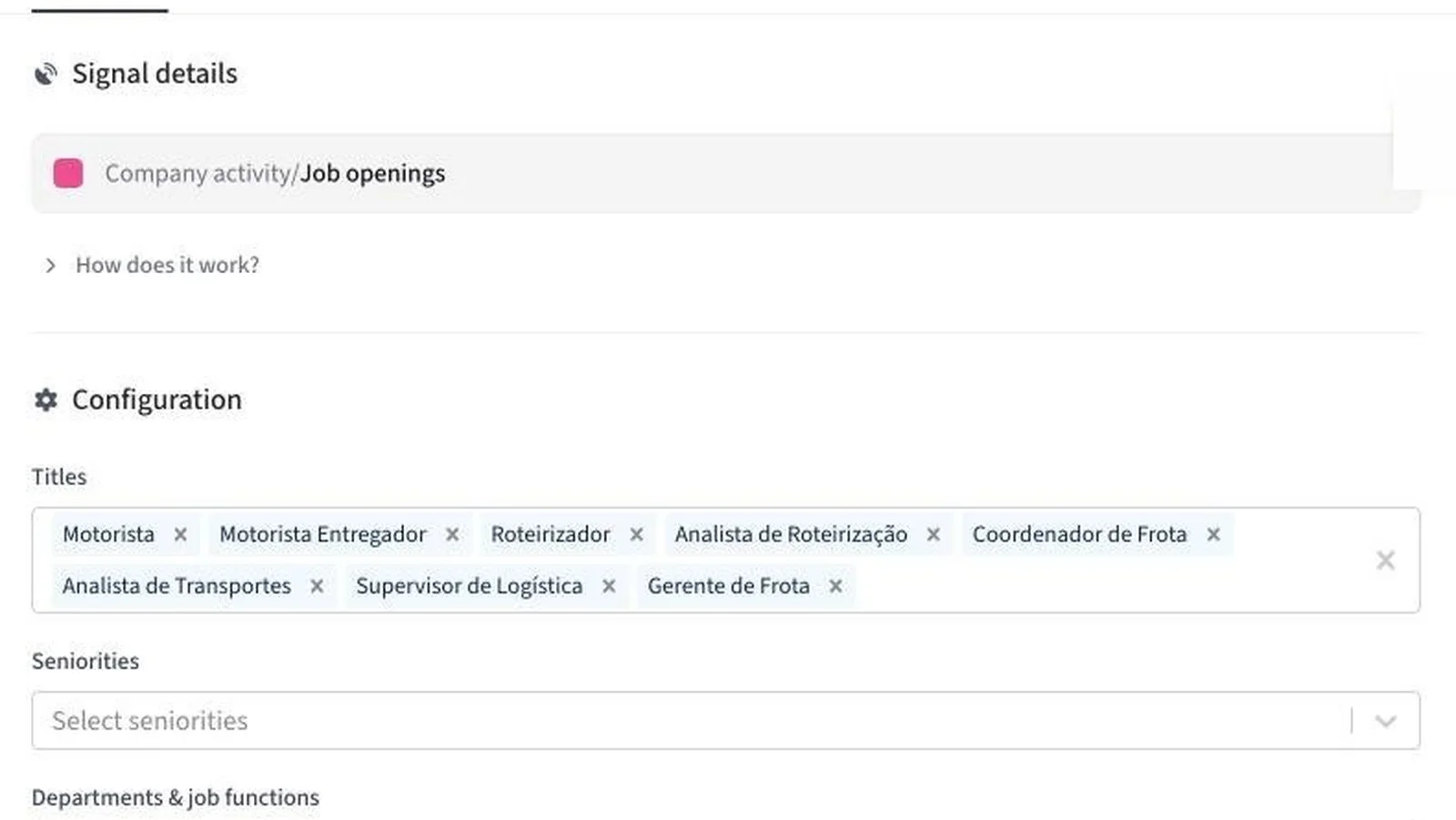
Custom signals worth building for logistics, via webhook or CRM:
Signal | Possible source | Useful variables for the message |
|---|---|---|
New distribution center or branch | News, new branch registration (CNPJ) | City, unit type, date |
Freight tender or contract | Procurement portals and official gazettes | Scope, region, deadline |
Rise in delivery complaints | Complaint websites | Main issue (delay, loss), change |
Traffic restrictions in the city | City halls (rotation, truck restriction zones, loading hours) [5] | City, restriction type, start date |
ERP or TMS change | IT job openings, news | System, project phase |
Seasonal peak | Industry calendar | Event (Black Friday, Christmas, Easter), days to peak |
5. Message by signal, not by persona
The signal sets the topic. The persona sets the angle. That's why I write the agent's instructions around the trigger:
Open with the observed fact, without sounding like surveillance. For example: "I saw you're growing your fleet team", not "I saw job posting 123 on site X".
Connect it to a likely operational consequence: more routes to plan with the same team, delivery windows, cost per delivery, real-time fleet visibility.
End with a diagnostic question ("how do you plan routes today?"), not a meeting request.
No pitch in the first message.
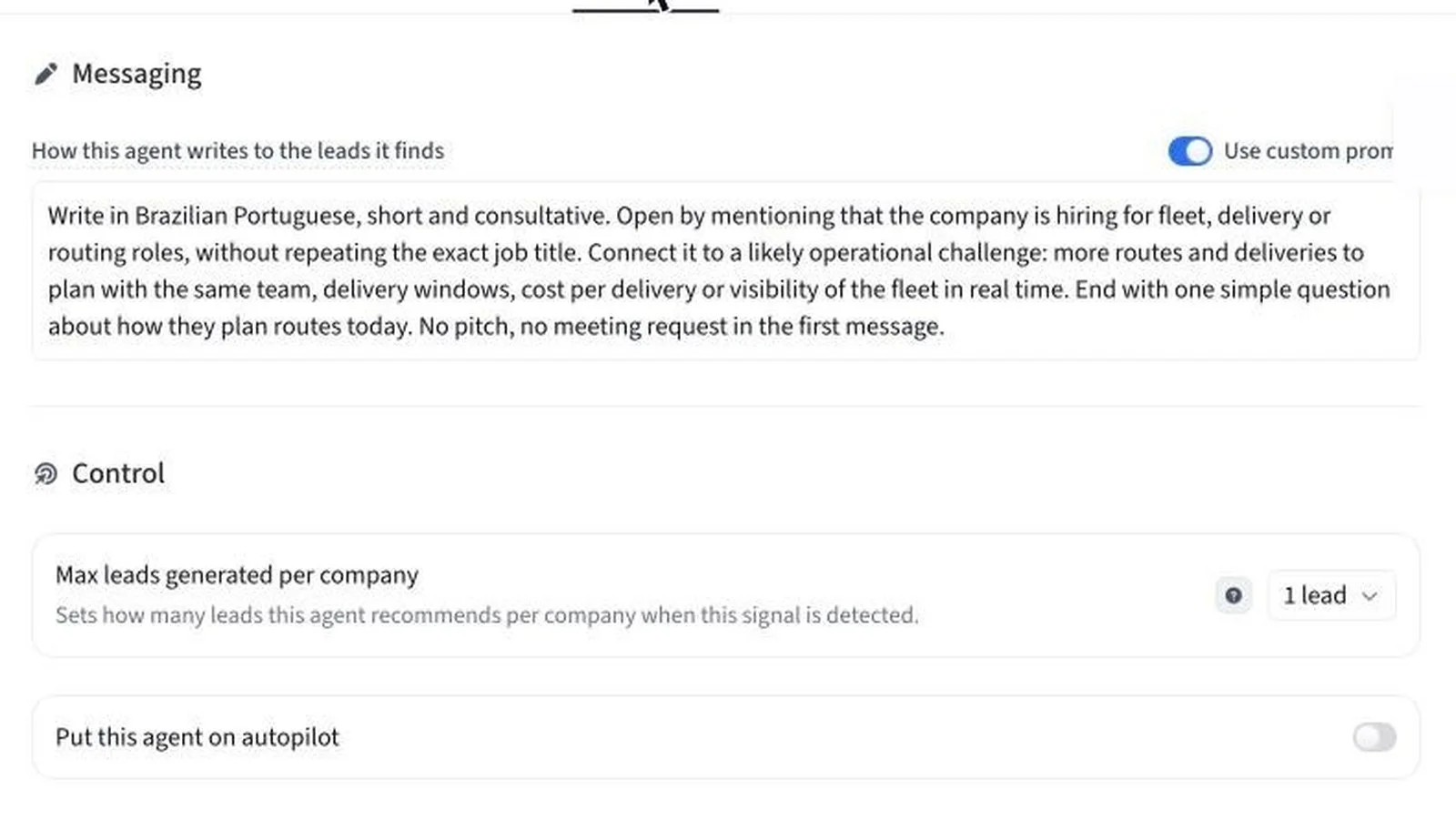
Same signal, two personas:
Fleet manager: "I saw you're hiring for the fleet team. That usually comes with more routes to close in the same shift. Is routing done in spreadsheets or in a system today?"
Logistics director: "I saw operations are growing. When volume rises, cost per delivery usually rises too before it stabilizes. Is that something you track today?"
6. Cadence: multichannel, with a clear role for each channel
Day | Channel | Goal |
|---|---|---|
1 | LinkedIn: invite with no note or a short note | Get on the radar |
2 | Email 1 | Signal + consequence + question |
4 | LinkedIn: message or audio in my own voice (Duo Voice) | Make it human. Name and company change for each person |
7 | Email 2 | One data point or industry case, no attachment |
10 | Call or WhatsApp, when there's a legal basis and context | Short conversation |
14 | Break-up email | Leave the door open |
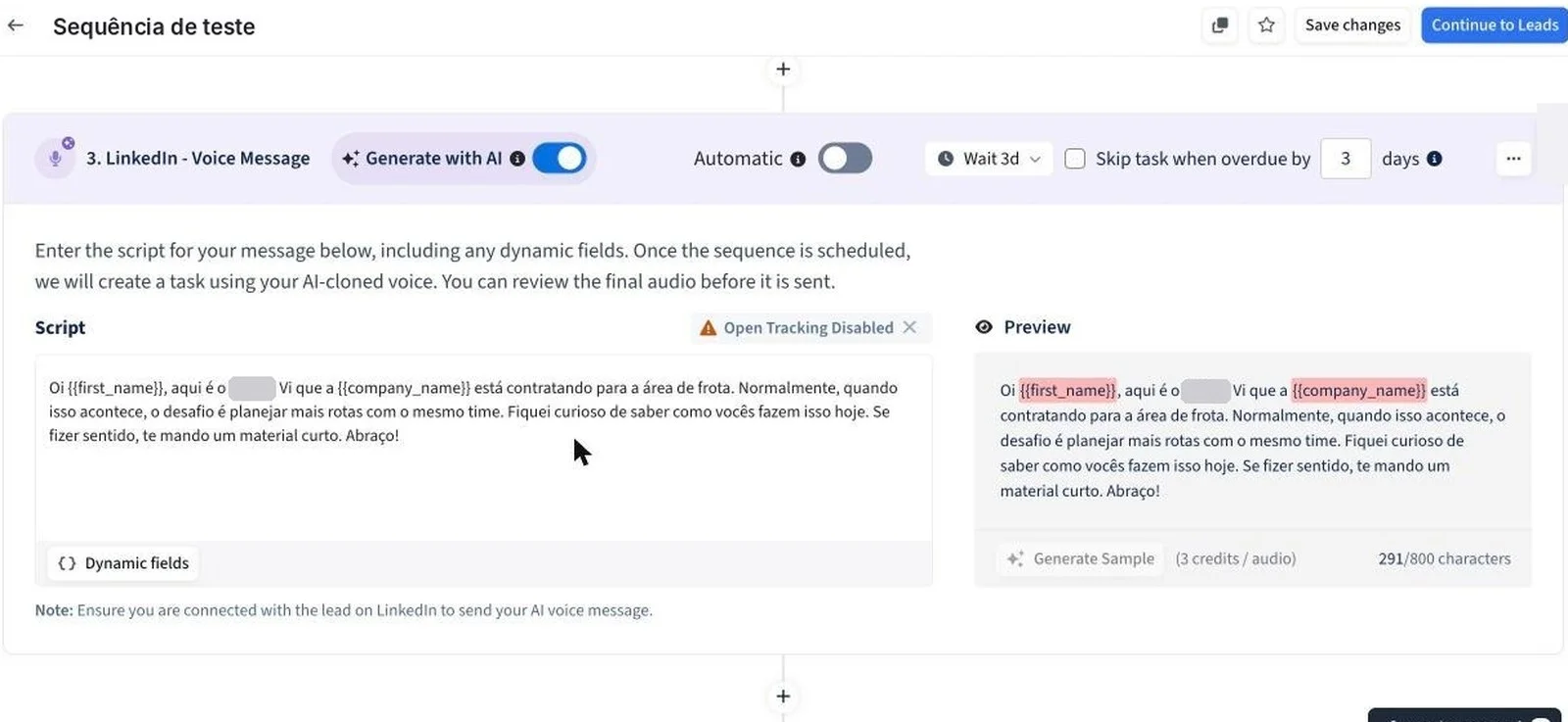
Audio works well in logistics because this audience spends little time reading. Duo Voice generates one audio per lead with your cloned voice, and sending goes through a task you review [4]. I review every audio before sending: a mispronounced company name destroys credibility.
7. Claude as an account analyst
With Amplemarket connected to Claude via MCP, Claude does the part that used to take hours per account. The requests I use most:
"Build a list of food distributors in Brazil's Northeast with their own fleet and an open driver position. Ignore logistics operators."
"For each account, estimate the number of distribution centers, regions served and approximate fleet size from public sources. Cite the source for each number."
"Cross-check with news from the last 90 days and tell me which accounts have more than one signal at the same time."
"Write the first message for the fleet manager and for the director, with different angles."
The rule: every data point comes with its source, and deciding who gets a message is still my call.
8. How to measure whether it works
I don't publish result numbers here. These are the indicators I track, and I recommend measuring them in your own market:
Reply rate by signal, not by campaign. It shows which signals really indicate a buying moment.
Time between signal and first touch. Layer-1 signals lose value fast.
Positive replies by persona, to see where conversations actually start.
Accounts with stacked signals versus a single signal.
9. Mistakes I've made that you can avoid
Treating 3PLs and own-fleet companies as the same audience. The messages cancel each other out.
Ignoring the owner in mid-sized companies.
Using the signal as a literal opening line. It sounds invasive and reads as spam.
Reaching several people at the same account on the same day.
Forgetting seasonality: close to peaks like Black Friday and year-end, operations have no time to evaluate anything new. Prospect earlier.
Ignoring Brazil's data protection law (LGPD): use professional data, document a legal basis (such as legitimate interest), make opt-out clear and don't reach out on personal phones without context [6].
10. How we apply this method at NORD
At NORD, this method is the foundation of what we deliver to B2B teams selling into logistics and other segments across Latin America and Iberia. In practice, we take on the part that usually stalls prospecting:
ICP and territory diagnosis: we separate who buys from who doesn't before any list, like the own-fleet cut in this article.
Signal design: we define the native and custom signals for each market, with the variables that feed the message.
Campaign operations: personas, multichannel cadences (email, LinkedIn, audio and WhatsApp) and human review before every send.
AI account research: we use Claude connected to Amplemarket to research each account, always with the source of each data point.
Measurement by signal: we track which signals create real conversations and adjust the strategy from there.
An agency's job isn't to send more messages. It's to make each message land at the right moment, for the right person.
The method in short
ICP by operations (own fleet), not by industry.
Five personas, with distinct roles in the purchase.
Signals in three layers, stacked to prioritize.
Recurring signals become agents, not manual searches.
Message by signal, angle by persona, a question instead of a pitch.
Multichannel cadence with a clear role for each channel.
Claude as an analyst, always with sources.
Measurement by signal, not by campaign.
Prospecting logistics well is less about volume and more about reaching companies at the moment their operations are changing. If you want to try this workflow, start with Amplemarket, and see the method in action in the full video on YouTube. And if you want NORD to design and run these signals with your team, for logistics or another segment, talk to us. For another example of custom signals, also read Leandro Klauck's post on this blog [7].
Felipe Souza is CEO and co-founder of NORD, a B2B pre-sales and outbound agency powered by AI, operating across Latin America and Iberia. NORD is an Amplemarket partner.
References
Ilos, "Logistics Costs and Their Impact on Brazilian Companies" study, via CNN Brasil: Custo logístico cai, mas ainda consome 15,5% do PIB (April 2026, in Portuguese).
Amplemarket: Custom signals.
Amplemarket help center: Custom API signals.
Amplemarket: Duo Voice Cloning: LinkedIn Voice Messages, a detailed guide.
São Paulo City Hall, Gestão Urbana: GeoSampa, vehicle traffic restriction lookup (in Portuguese).
Law No. 13,709/2018 (LGPD), Planalto (in Portuguese).
NORD blog: How to find custom buying signals with AI.